Homelab Infrastructure, Simulated Properly
Silicon Pirates is a browser-based rack simulator where power, networking, and
storage aren't abstractions, they're systems you actually wire together. Rack
real devices, run real cable topology, and watch load, heat, and uptime respond
to the choices you make, not a progress bar.
You start with $1000 in Lab Credits and an empty rack. Everything from there,
what you buy, how you wire it, whether it survives a fault, is on you.
Also playable on your phone: sp.silicon-pirates.com/m/ -- same account, same rack, no separate signup.
You can play the whole game with zero signup, your rack saves and resumes
automatically either way. But registering a real username, free, inside the game
(click your name in the top bar), locks it in permanently, guaranteed, and unlocks
the Marketplace: real cross-session trading with other actual
players for racks, devices, and cosmetic trinkets. Every item you register also
keeps a full, readable ownership history from the moment you get it onward, through
however many hands it passes through after.
Your existing save, chips, and progress don't change when you register, it just
attaches a real identity to what you already have.
See the full breakdown in the Marketplace manual.
The browser build is live and playable right now, free, no install.
It's a genuine work in progress: new systems, devices, and balance passes ship
regularly, and this site tracks the current state as closely as it can.
Follow active development on r/SiliconPirates,
or see what's shipped so far versus what's still ahead on the
Roadmap.
Core Systems
- 30-device rack roster: PDUs (5 tiers), UPS (3 tiers), routers, firewalls, switches (4 sizes), NAS (3 tiers), servers, application servers (3 sizes), AI compute, crypto rigs, hosted game servers, terminal servers, log servers, backup appliances, KVM consoles, a Gambling Server, and a Comm Device, each bought as a real, individual unit, not an unlimited unlock
- Real power distribution: grid slots, PDU/UPS chains, overload and brownout risk down to individual outlets, an hourly bill that swings with both your own load AND real time-of-day peak/off-peak pricing, and genuine disconnection (and a paid reconnection) if that bill goes unpaid too long
- An overloaded PDU chain can genuinely catch fire, and that fire can spread to every device plugged directly into it, not just the PDU itself
- Layered networking: routers, switches, DHCP, ISP uplink, a full terminal command set to diagnose it, and a live bandwidth graph driven by your actual hosted-game players, AI compute rentals, and mining activity, not a canned animation
- NAS-backed storage with real capacity, growth, sharing, and failure states, disaster recovery (mirror a share to another device and it survives a fault the primary wouldn't), and a rack-wide storage overview showing exactly how much of your capacity is unprotected right now
- A full terminal: `man` documentation across 20+ topics, scripting, cron automation, and live diagnostics on every wired device
- An offensive and defensive hacking loop: firewalls and Heat/Reputation on one side, a rotating target board and scan/exploit/steal hacking tools on the other
- Opt-in live hacking against other real accounts: a four-phase attack of mini-games drawn from a pool of sixteen, a real defence you can play back, an alarm that reaches you anywhere in the game, and per-account limits so nobody can camp you. Chips can never be hacked or siphoned — only credits and crypto ever move
- Custom racks and cross-rack cabling, so a single-rack setup can grow into a multi-rack operation with shared links between them, including full cross-rack PDU/UPS power sharing -- a cross-rack-powered device behaves identically to a locally-powered one in every system
- Three recurring hacker collectives (one assigned at random per rack, each with a distinct personality) with ransomware, a mailbox, and a hackback path once you're far enough in
- A darknet market for grey-market repair parts and exploit kits, plus a separate used device market for buying and selling physical units at fluctuating, rolled-condition prices
- Client contracts, including black-box security audits that actively trigger a fault to test your response instead of just checking ambient state
- Device degradation, thermal modeling, and random faults that force real maintenance decisions
- Anonymous, zero-signup save/resume, so your rack is exactly as you left it next time, no account required, plus a one-click Reset Save if you'd rather start clean (any Chips you've bought are always kept)
- Optional free registration locks in a permanent username (never lost or reset) and unlocks the player Marketplace: real cross-session trading with other players for racks, devices, and cosmetic trinkets, each carrying a full, readable ownership history forever
- The Comm Device: a live directory of other active players — usernames, Reputation rank, and how recently they were online — reachable either through the device itself or a terminal
players command
- Dark Room mode: dim the rack view down to real low-light lab lighting, servers and chassis barely visible, every LED and cable glowing bright against the dark, free for every player regardless of tier
- A premium shop (chips): cosmetic device/rack skins, full-UI accent themes, a custom rack nameplate, time-savers like a Hacker Ward, an Insurance Policy against your next fault, or a Device Insurance charge for a destroyed one, a one-time Cable-Tie Auto-Organize that routes cables into clean left/right rails, plus a same-value chips option to escape active ransomware -- never anything that outperforms honest free play
- Terminal-tracked achievements that pay a real one-time cash + Reputation bonus the moment you earn them, and a fully playable DOOM easter egg hidden in the simulation
In-Game Screenshots
These screenshots are taken directly from the active development build.
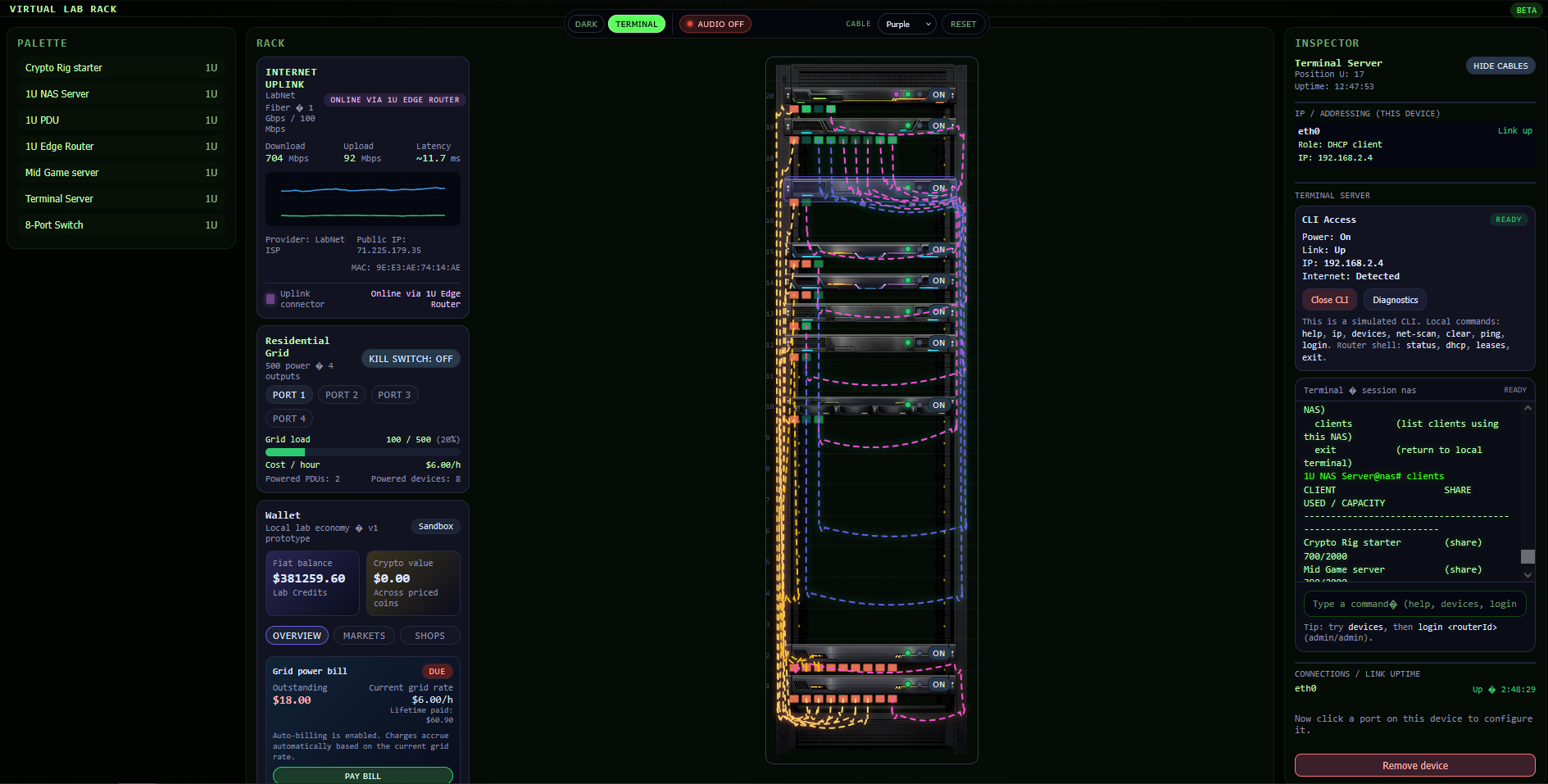
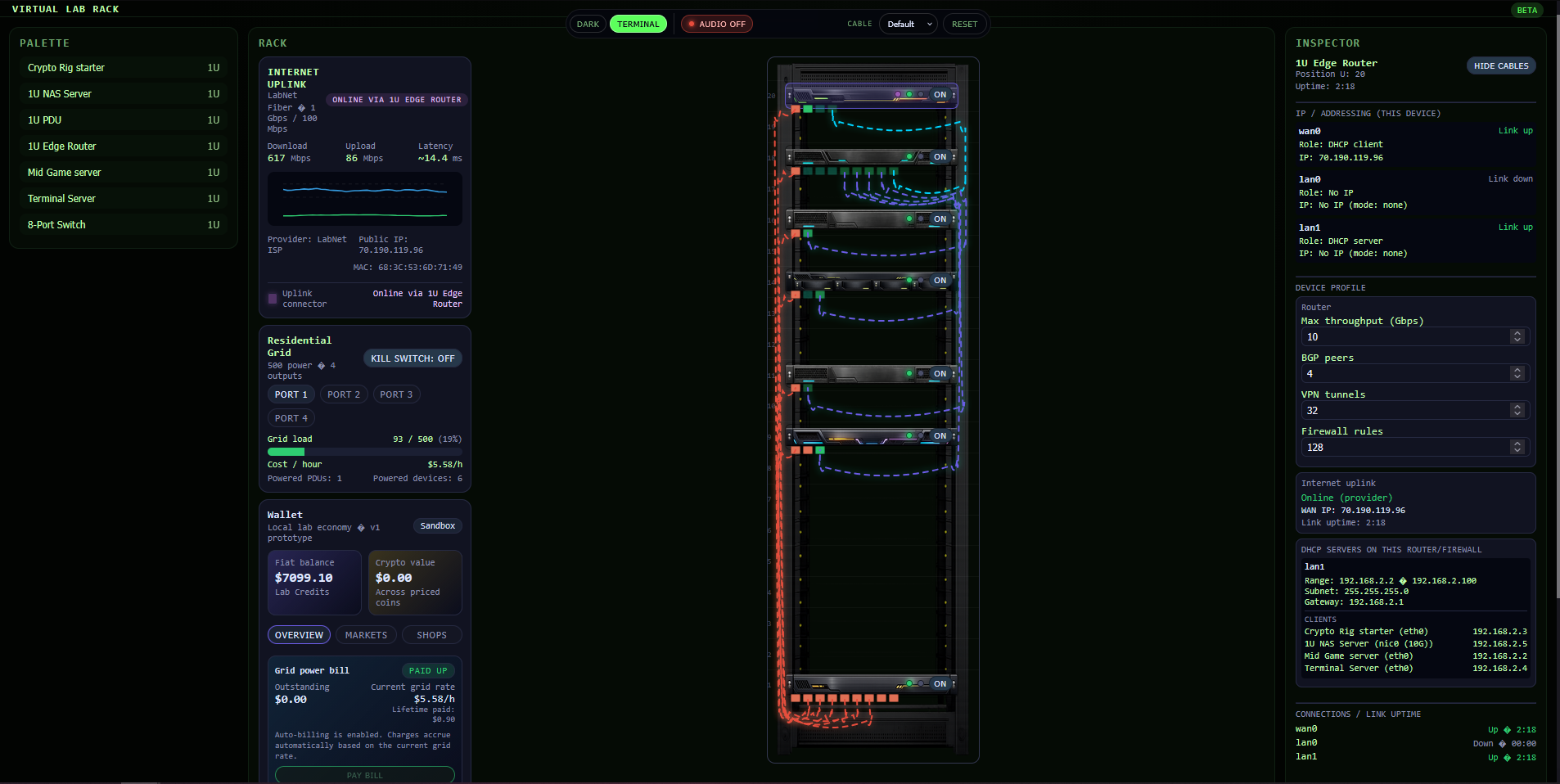
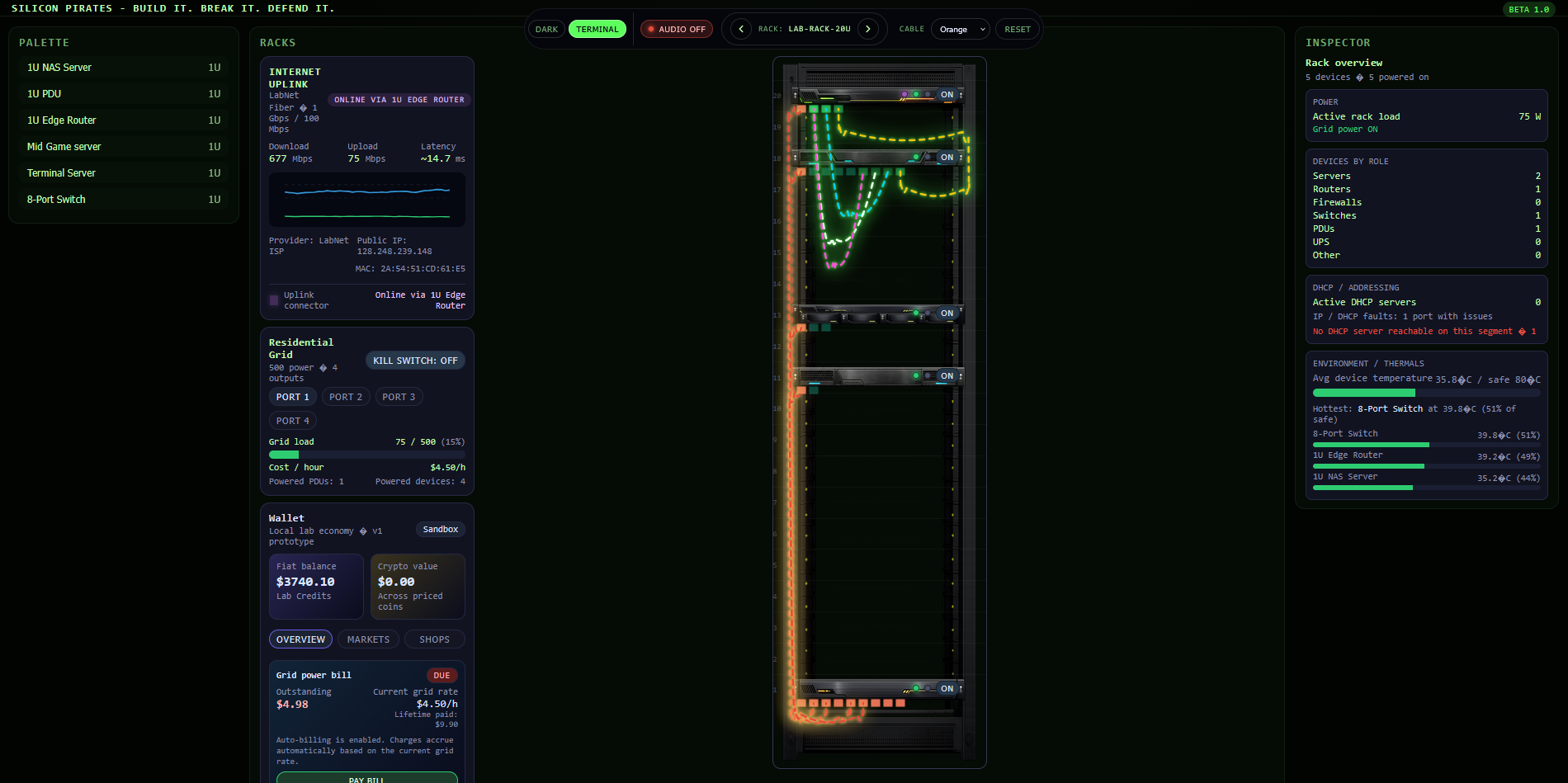
Everything shown, power draw, device state, networking, terminals, LEDs,
and failure conditions, is simulated in real time.
This is not a cinematic mock-up or static UI. What you see reflects actual
game state, configuration choices, and system behavior as it exists in the
current build.
Rack Overview / Power & Thermal State
Terminal Server / Live CLI Control
Networking / DHCP / ISP Uplink
Your Own Data Center / Fully Wired Rack
Wallet Markets / Pump Predictor Mini-Game
Client Contracts / Lab Credits + Reputation
Visuals, layout, and device skins will continue to evolve as systems are finalized.
In-Game Videos
Real clips from the active development build. These are not trailers, this is live simulated state.
Click any panel to open full playback.
Video previews are muted by design. Full playback opens in a dedicated page with controls.
Live Hacking
The rest of the game is you against the simulation. This is you against other real
operators — real accounts, real racks, real credits moving between them. It is the
only system where another person can take something of yours, so it is the only one that is
opt-in and stays off until you deliberately switch it on.
Opting out is one button, always available, with no confirmation and no cooldown. Opting in
makes you attackable straight away but bars you from attacking anyone for six hours —
the risk lands before the advantage does, so the switch can never be used as a weapon.
An attack is four rounds — recon, breach, persist, payload —
each a different puzzle drawn from a pool of sixteen, so no two runs are the same. Lose any
round and the run is over. Win it and you siphon half of what the rack is carrying, capped
at 25,000 credits, and only 40% of that if nobody was home to defend. An unattended rack is
a smaller prize on purpose: waiting for somebody to log off is not a strategy here.
You are never robbed silently. An intrusion raises an alarm anywhere in the game, naming who
it is and how far they have got, and you can play a defence round to repel them outright
— nothing taken, no downtime, and an hour to hit back. Losing a defence costs
you nothing extra, so trying is always worth it. Or pull the plug: it always works,
and it always costs you.
Nobody can camp you. Two hours untouchable after a robbery, six hours before the same
attacker can return, ten attacks a day each, and every limit counted per account rather than
per rack. Chips can never be hacked or siphoned, by anyone, ever —
only credits and crypto ever move.
Some racks in the directory are run by the house, and the game does not tell you which. They
carry real loot, and they attack back on the same rules — 150 seconds to answer, no
more than once every 12 hours, and never against a rack below 60 Reputation.
The House
Rack a Gambling Server and you get the house slot machine, playable from
any terminal or from the device's own panel. It pays Lab Credits only —
the real-money currency is never involved.
The odds are published rather than hidden: the paytable shows the exact chance of every
symbol and a return-to-player of 93.5%, with something paying on about 28%
of spins. Over a long session the machine still takes more than it gives, and it says so.
Two jackpots. One resets hourly and is yours alone. The other is
shared by every player in the game, starts at 100,000 credits, grows with
every spin anywhere, and when somebody takes it their name appears on every gambling server
in the game and everyone is notified.
It is also the heaviest device in the roster — 620W typical against a 900W ceiling,
running hot enough that cooling is close to mandatory — and it needs a NAS share to
keep its ledger, which you can read and purge.
The School
Silicon Pirates has its own institute. Blackport Institute of Technology
teaches the systems you are actually running — power and redundancy, thermals and
maintenance, networking and addressing, storage and backup, security and defence. Every
lesson says how the thing works, why you would reach for it, and what it costs you.
Each of the five courses ends in its own practical exam. Pass one and you are paid in Lab
Credits, awarded a certificate for your public profile, and given a permanent discount on
the hardware that course covers. Collect the certificates in a track and you hold a
diploma; hold every diploma and you graduate.
Service Manuals
Every device in Silicon Pirates ships with internal-style documentation.
Learn how systems behave, fail, and recover, just like a real lab. The same
docs are also searchable live in-game via the terminal's man <topic>
command and the Library panel.
Support Development
Silicon Pirates is built like a real lab: power, networking, storage, failure states, recovery,
a real anonymous save system, and terminal workflows that actually change state. That level of
simulation takes time, testing, assets, and real infrastructure (this site and the game both run
on infrastructure I pay for and maintain myself), and I'm building it independently.
The fastest way to support the project still costs nothing: play it, tell people about it, and
send feedback through Contact. If you'd rather support it
directly, the in-game premium shop (cosmetic skins, themes, and time-savers, never anything that
outperforms honest free play) is the one real way to do that right now. Longer-term plans for the
project, including what additional funding would accelerate, are laid out honestly on the
Roadmap.
HOW TO HELP
▸
Play and share: the browser build is free, and word of mouth is the biggest lever a solo project has
▸
Buy cosmetics in-game: the premium chip shop funds real hosting and infrastructure costs directly, no pay-to-win, ever
▸
Report what's broken: bug reports and balance feedback go straight into the next build
▸
Follow along: dev logs and milestones post to r/SiliconPirates as they ship
DEVELOPMENT STATUS
Active
Browser build: Live
Mobile Companion App: Full-Featured
CURRENT FOCUS
Mobile companion covers the full game (Darknet, Hacking, a real terminal, the Comm Device directory, and a private Notebook with rack/device screenshots -- DOOM stays desktop-only on purpose), a real device pass next, multiplayer (PvP raiding + AI opponents), balance passes, and expanding service manual coverage